
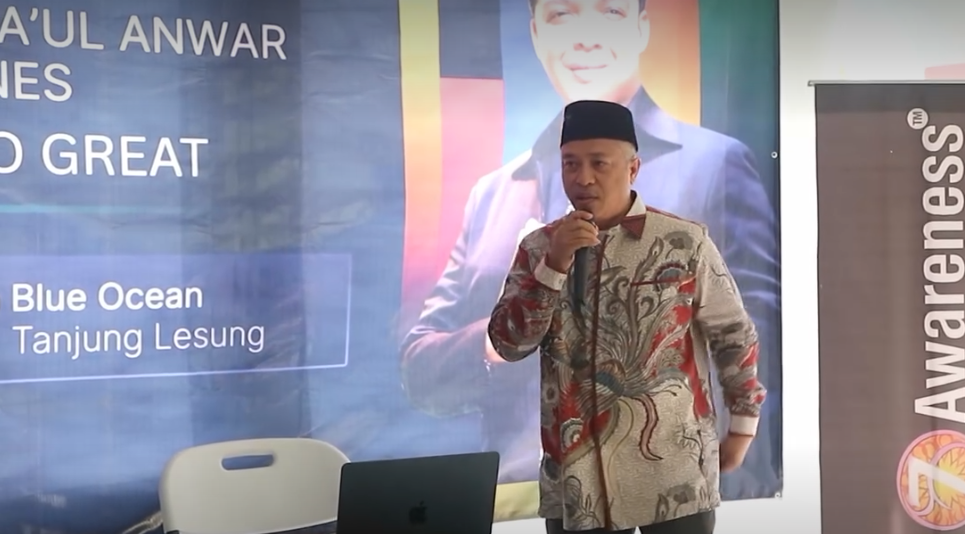
PANDEGLANG, The Banten Post – Opposition to the proposed relocation of Javan rhinoceroses from Ujung Kulon National Park is coming not from the entire Mathla’ul Anwar organization, but from the Residents of the Mathla’ul Anwar Educational Institution in Menes, Pandeglang, Banten. The distinction matters. The statement represents a local educational and religious community connected to the Ujung Kulon landscape, not an automatic decision on behalf of every Mathla’ul Anwar institution or structure.
In a statement dated November 17, 2026, the residents rejected the proposed transfer of Javan rhinos (Rhinoceros sondaicus) to another area, including Alas Purwo National Park in East Java. They called on the government not to capture or relocate any rhinos before an independent scientific assessment, an impact review and meaningful public consultation have been completed.
The statement comes as the government presents a second habitat as a conservation strategy intended to reduce the population’s exposure to disasters and other threats. The local group acknowledges that a concentrated population can be vulnerable. But it argues that this rationale does not answer the central question: would removing animals from Ujung Kulon actually reduce the risk, or would it create a new risk for the source population?
Relocation is not a simple conservation solution
The Residents of the Mathla’ul Anwar Educational Institution in Menes are asking for more detailed population data before any decision is made. They say the process must consider the actual number of rhinos, age structure, the balance between males and females, health conditions, genetic diversity and breeding potential.
The status of a destination as a national park is not enough to prove that it is suitable habitat. Food sources, water, wallows, range, security, disease risks and carrying capacity must all be examined. Even if a destination is declared suitable, capture, transport and adaptation would still expose the animals to additional stress and uncertainty.
That caution is also linked to the previous translocation experience involving Musofa, a Javan rhino that died during the process. His death should not be treated as an administrative episode that ends with an official explanation. It should prompt a transparent review of the full chain of decisions: who assessed the animal’s readiness, how the risks were calculated, how the transport was managed and who was accountable when the process failed.
The group’s position also places relocation within the wider problem of wildlife protection. Strengthening patrols, preventing poaching, restoring habitat, monitoring disease and involving local communities may address the underlying risks more directly than moving animals before the source landscape has been fully secured.
A local voice with its own institutional identity
The statement reflects a community that says it has social, cultural, educational and everyday ties to Ujung Kulon. That connection is why the residents are asking to be involved before a technical decision becomes irreversible.
Public consultation should not be reduced to a meeting held after the location, method and animals have already been selected. Residents need access to the studies being used, the alternatives considered, the number of animals proposed for relocation and the criteria for measuring success or failure.
The wording of the organization’s name is part of that accuracy. Describing the statement simply as a position of “Mathla’ul Anwar” would broaden the source beyond what the document establishes. The signatory is Mohammad Zen Hafidz, chairman of the Mathla’ul Anwar Educational Institution in Menes, acting on behalf of its residents. The statement should therefore be attributed to the Residents of the Mathla’ul Anwar Educational Institution in Menes.
That distinction does not make the concern less significant. It makes the reporting more precise. A local institution may have an autonomous voice and a direct relationship with the affected landscape without claiming to speak for an entire national organization.
The government is being asked to show its evidence
The residents are calling for stronger habitat protection, anti-poaching enforcement, patrols, ecosystem restoration, disease surveillance and community empowerment. They are also asking for an assessment of Ujung Kulon’s World Heritage values and consultation with relevant institutions if the proposed plan could affect the park’s integrity.
The statement does not necessarily reject every future proposal for a second habitat. It challenges the assumption that relocation is automatically synonymous with conservation. Before moving any animal, the government should publish the population data, explain which individuals could safely be selected, disclose the relocation protocol and set out what happens if an animal dies or fails to reproduce.
The unresolved question is therefore not simply whether a Javan rhino can be moved. It is whether the government can demonstrate that moving it produces a greater conservation benefit than protecting and restoring the habitat where the remaining population still survives.


