TANGERANG/JAKARTA — For travelers in Banten and Jakarta, the most immediate consequence of Anak Krakatau’s September eruption was not an evacuation but a sudden loss of the region’s air links. Volcanic ash forced the temporary closure of Soekarno-Hatta International Airport in Tangerang, Halim Perdanakusuma Airport in Jakarta and six other airports, leaving passengers to wait, rebook, seek refunds or find another way across Indonesia.
The disruption followed a prolonged episode of activity at Anak Krakatau, the active volcano in the Sunda Strait. Indonesia’s Geological Agency said the continuous-eruption phase began at 11:07 p.m. Western Indonesia Time on Friday, September 4, and ended at 12:04 a.m. on Sunday, September 6. Lava fountains, ash and loud booms were observed during the episode. The volcano is administratively in South Lampung, but it is also monitored from Pasauran in Serang, Banten, and Kalianda in South Lampung.
Why the airports stopped
Aviation authorities treated the ash as an operational safety problem, not simply a visibility issue. Volcanic particles can damage aircraft engines and other critical systems, so AirNav Indonesia restricted airspace around affected airports while authorities repeatedly checked how the ash was moving. Ash-advisory information cited by PBS NewsHour put one plume at roughly 6,100 metres, drifting toward Jakarta, Banten and West Java, and another at about 15,200 metres over parts of Banten, Lampung and Bengkulu.
Antara reported that the first round of disruption at Soekarno-Hatta involved 764 flight movements: 570 domestic passenger flights, 185 international passenger flights and nine cargo flights. The airport’s suspension was extended to 5:30 p.m. on Sunday as the ash spread. By the time the wider shutdown ran through Sunday and Monday, the total had grown sharply. The Associated Press reported that nearly 2,961 flights were disrupted and about 341,000 passengers were affected.
Inside the terminals: screens, queues and uncertainty
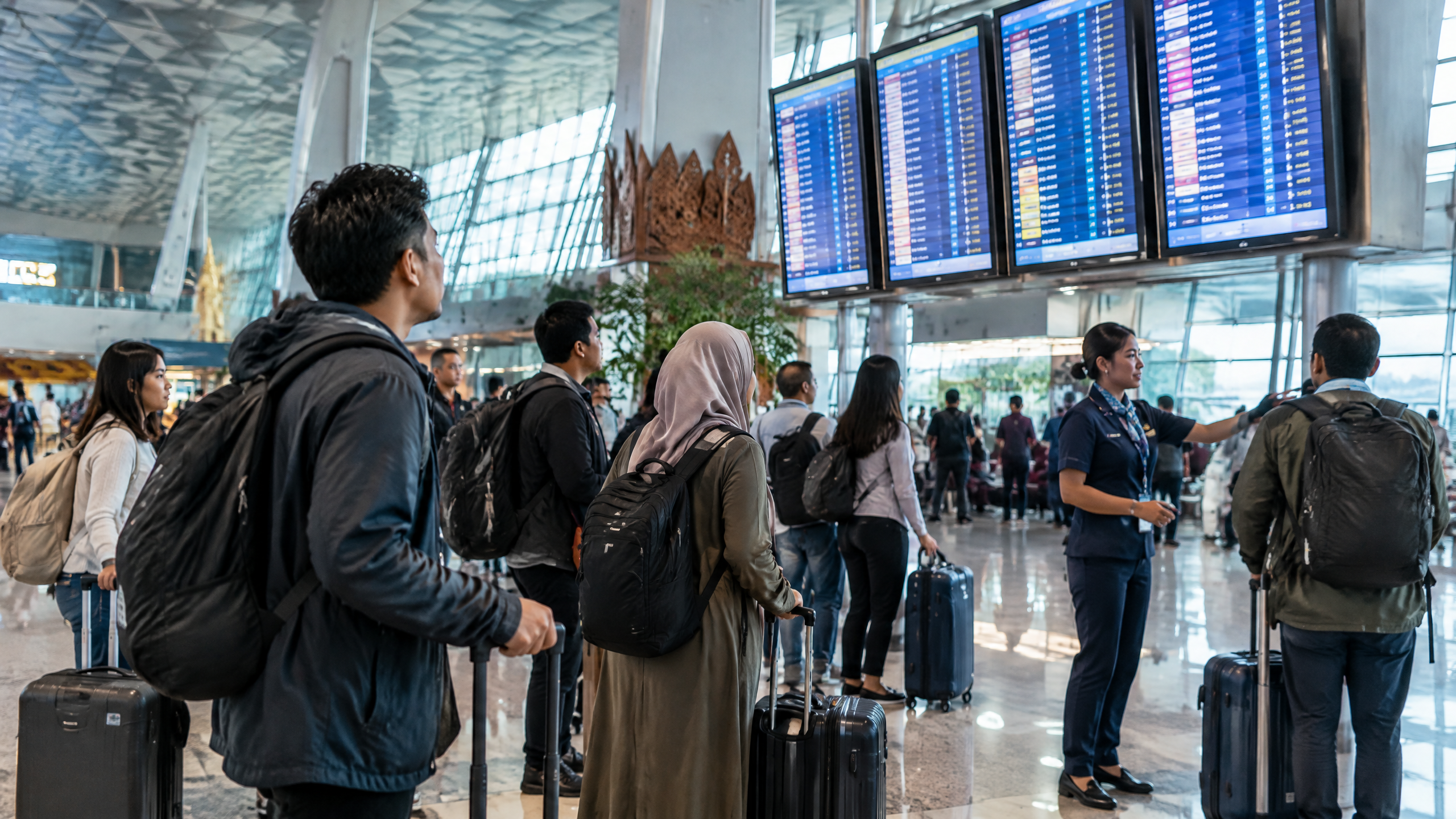
At Soekarno-Hatta, passengers faced the familiar airport signs of a disruption that kept changing: long departure-hall queues, crowded waiting areas and repeated searches for reliable updates. BBC reporting described travelers clustering around flight-information screens as schedules were repeatedly revised. Some were seeking refunds; others were trying to determine whether they should remain at the airport or arrange an alternative journey.
One traveler interviewed by the BBC, Finna, abandoned the uncertainty of a rescheduled flight from Malang and used two intercity trains before reaching Jakarta in the early hours of Monday. A visiting conservation group also dropped plans to camp at Ujung Kulon National Park after authorities raised the volcano alert level. Their experience showed how the disruption reached beyond the terminal: an air-travel interruption quickly became a question of trains, hotels, park plans and cash for additional days on the road.
Passengers who stayed at the airport were not simply left without assistance. Soekarno-Hatta management activated a Service Recovery Action protocol and an operations post at Terminal 1B. Antara reported that airport authorities and airlines provided food and drinks, arranged shuttle buses to nearby hotels, opened special rest areas and instructed retail and food outlets to operate around the clock during the closure.
What happened after the shutdown
The closure did not end when the ash first moved away. Soekarno-Hatta resumed operations at about 12:30 a.m. on Tuesday, September 8, after authorities judged conditions safe for aviation. Halim and three other regional airports also reopened around that time, while other airports returned to service later. Before flights resumed, authorities required aircraft inspections and told crews to observe restricted-airspace zones.
That reopening restored the main route for passengers in the Jakarta metropolitan area, but it did not erase the backlog. Airlines had to reposition aircraft, rebuild crew and aircraft rotations and process passengers whose flights had been canceled or diverted. During the shutdown, the Transportation Ministry said carriers should provide clear updates and guarantee ticket refunds. It also identified Kertajati, Semarang, Surabaya and Yogyakarta as possible alternative hubs outside the ash-affected area.
What we know
- Eight airports were temporarily closed during the peak disruption, including Soekarno-Hatta, Halim, Budiarto in Curug and Pondok Cabe in South Tangerang.
- Soekarno-Hatta’s first reported disruption was 764 affected movements; the two-day, multi-airport impact later reached nearly 2,961 flights and about 341,000 passengers.
- The continuous-eruption episode ended on September 6, but the volcano returned to intermittent Strombolian activity. The Geological Agency recorded further eruptions and kept Anak Krakatau at Level III, or Siaga.
- Authorities continued to prohibit people from entering or conducting activities within 3 kilometres of the active crater. No evacuation order or tsunami warning linked to this episode was reported, but officials urged coastal residents to follow local BPBD guidance and avoid hoaxes.
The position on September 20
For travelers planning a Banten or Jakarta journey, the verified picture is therefore two-part: the September 6–8 airport emergency had passed, but the volcanic hazard had not been declared over. The latest official update located for this article, issued by the Geological Agency on September 11, said surface intensity was declining and had shifted back to Strombolian eruptions, while deeper volcanic earthquakes remained elevated and the possibility of renewed eruptions was still considered high.
No newer official aviation closure bulletin was located in the sources reviewed for this September 20 article. Travelers should check their airline and airport directly before leaving for a terminal, particularly if ash is reported or weather changes. The official monitoring channels identified by authorities are the Geological Agency, PVMBG and MAGMA Indonesia. The lesson from the shutdown is simple: a reopened runway does not instantly restore a normal schedule, and a quieter volcano does not automatically end the need for caution.
Sources
- https://en.antaranews.com/news/430164/mount-anak-krakatau-eruption-impacts-764-flights-at-soekarno-hatta
- https://en.antaranews.com/news/430175/mount-anak-krakatau-eruption-grounds-eight-indonesian-airports
- https://geologi.esdm.go.id/media-center/fenomena-erupsi-menerus-gunungapi-anak-krakatau-tanggal-5-september-2026
- https://www.esdm.go.id/id/media-center/arsip-berita/aktivitas-anak-krakatau-terus-dipantau-pvmbg-pastikan-status-siaga-tetap-berlaku-usai-erupsi-menerus-25-jam
- https://www.esdm.go.id/en/media-center/news-archives/erupsi-menerus-anak-krakatau-berakhir-aktivitas-gunung-api-kembali-menurun-dan-tetap-dipantau
- https://esdm.go.id/en/media-center/news-archives/intensitas-erupsi-anak-krakatau-menurun-badan-geologi-tetap-waspadai-aktivitas-magma-dalam
- https://www.bbc.com/news/articles/czezydp4l97o
- https://www.pbs.org/newshour/world/volcanic-island-in-indonesia-erupts-forcing-the-cancellation-of-hundreds-of-flights
- https://apnews.com/article/indonesia-airports-flights-anak-krakatau-volcano-eruption-311bf9e4c81e4b5ff0c55a0406e7edd3