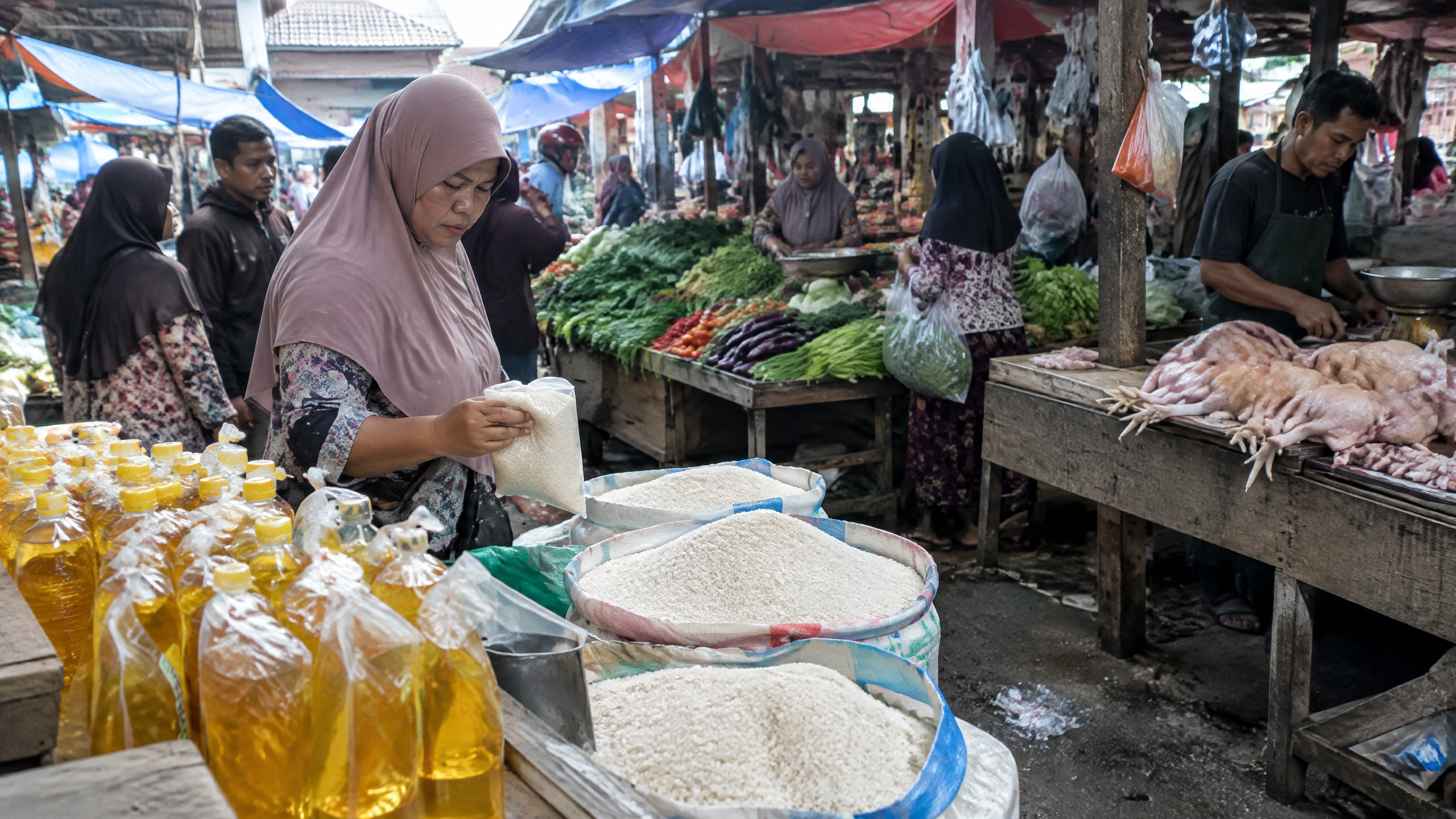
For households in Serang, Banten’s 2026 macroeconomic agenda will not be judged first by a growth forecast or a provincial budget balance. It will be judged at the market: whether rice, cooking oil, chicken, shallots and transport remain affordable from one week to the next.
That makes the province’s inflation strategy a political issue as much as an economic one. Bank Indonesia’s May 2026 regional report projects Banten’s economy will grow between 5.1 percent and 5.9 percent this year, while inflation is expected to remain within the national target of 2.5 percent plus or minus 1 percentage point. The policy question for Serang is whether that growth can protect household purchasing power rather than simply lift regional output.
The latest price data show improvement, but not a clean bill of health
The most recent 2026 year-on-year figure listed in BPS-Statistics Indonesia’s Banten series is 2.95 percent for August, with monthly inflation of 0.13 percent. September’s official provincial reading was not yet available on the 20 September work date, so the August figure is the latest comparable evidence in this article.
That is a significant easing from the first quarter. BPS recorded 5.14 percent year-on-year inflation in Banten in February, when monthly inflation reached 0.93 percent. Food, beverages and tobacco contributed 0.81 percentage points to the monthly increase. Broiler chicken, cayenne pepper and shallots were among the main upward contributors.
Serang’s own February reading was more severe than the provincial result: 5.70 percent year-on-year and 0.73 percent month-on-month. BPS identified housing, water, electricity and household fuel as the largest annual pressure, with that group rising 31.31 percent. Food, beverages and tobacco rose 4.07 percent. By March, a Serang municipal government report put inflation at 3.79 percent, suggesting the pressure had moderated, but it did not disappear from household budgets.
Why the province is focusing on supply rather than only demand
The structure of Banten’s economy helps explain the policy emphasis. The province contains both major consuming cities and production areas. Bank Indonesia and the provincial government identify Kabupaten Serang, Pandeglang, Lebak and Tangerang as production centres, while Tangerang, South Tangerang and Cilegon are major consumption areas. Serang sits inside that distribution network, so a harvest or a price shock elsewhere can quickly become a local retail problem.
At a February high-level meeting, the provincial government said Banten’s 2026 food balance was projected to show a rice surplus of about 58,000 tonnes, with the peak harvest expected in February and March. The province and its regional inflation-control team also prepared cheap-food markets, market operations and steps to keep strategic commodities moving. The stated framework is the familiar “4K”: affordability, supply availability, smooth distribution and effective communication.
For Serang residents, the practical test is narrower. The city’s inflation-control team said it had prepared Rp37.6 billion in budget interventions through several agencies. Officials highlighted MinyaKita cooking oil, as well as onions, chicken and beef, and said they would coordinate with Bulog and the provincial government to secure supplies. The city also described cheap-food programmes in which a staple package valued at more than Rp200,000 was sold for Rp30,000. Such programmes can cushion a shock, but they are temporary support, not a substitute for reliable normal-market prices.
Growth is strong, but its household effect depends on jobs and credit
Banten’s economy grew 5.37 percent in 2025, up from 4.79 percent in 2024, according to BPS. In the first quarter of 2026, Bank Indonesia reported 5.64 percent year-on-year growth. Household consumption grew 5.92 percent, investment 6.09 percent and government consumption 14.93 percent. Agriculture, transport, trade and accommodation were among the sectors supporting the quarter.
Those figures suggest a solid demand base, but they do not mean every Serang family feels better off. Bank Indonesia reported Banten’s February 2026 open unemployment rate at 6.59 percent, only slightly below 6.64 percent a year earlier. Its May report also said micro, small and medium-enterprise credit was still contracting year-on-year, although the contraction had improved. In other words, the economy is expanding while access to work and business finance remains uneven.
The provincial KUA-PPAS for 2026 sets regional revenue at more than Rp9.94 trillion and spending at more than Rp10 trillion, with a projected deficit of about Rp57.04 billion. The provincial government says the framework was adjusted to current macroeconomic conditions and should prioritise spending with direct public impact. For Serang households, that promise should be measured against the visibility of food distribution, transport links, market monitoring and protection for vulnerable consumers.
What we know
- Banten’s latest listed inflation reading before 20 September 2026 was 2.95 percent year-on-year in August, with monthly inflation of 0.13 percent.
- Serang recorded 5.70 percent year-on-year inflation in February, then 3.79 percent in the March figure cited by the municipal government.
- Bank Indonesia projects 2026 Banten growth at 5.1–5.9 percent and inflation within 2.5 percent plus or minus 1 percent.
- Rice supply, MinyaKita, animal protein, onions and distribution are the clearest household-facing pressure points identified by local authorities.
- No September 2026 provincial inflation release was available by the work date, so the latest price assessment remains provisional.
The central choice for 2026 is therefore not growth or inflation in isolation. It is whether public money and intergovernmental coordination can turn strong regional indicators into predictable prices in Serang’s markets. If supply arrives on time and interventions are targeted, the macro agenda may become visible as a steadier household budget. If distribution fails, a favourable provincial average will offer little comfort at the checkout.
Sources
- https://banten.bps.go.id/en/statistics-table/2/MjE5IzI=/monthly-year-on-year-inflation-in-banten-province.html
- https://banten.bps.go.id/en/news/2026/03/03/87/awal-ramadhan-2026–inflasi–month-to-month—di-provinsi-banten-sebesar-0-93-persen–tertinggi-di-kabupaten-pandeglang—terendah-di-kota-tangerang-.html
- https://serangkota.bps.go.id/en/pressrelease/2026/03/02/120/serang-municipality-consumer-price-index-development-february-2026.html
- https://banten.bps.go.id/en/pressrelease/2026/02/05/923/banten-s-economy-grew-by-5-37-percent-in-2025–c-to-c-.html
- https://www.bi.go.id/id/publikasi/laporan/lpp/Pages/Laporan-Perekonomian-Provinsi-Banten-Mei-2026.aspx
- https://www.bi.go.id/id/publikasi/laporan/lpp/Pages/Laporan-Perekonomian-Provinsi-Banten-Februari-2026.aspx
- https://bantenprov.go.id/berita/gubernur-andra-soni-perkuat-pengamanan-pasokan-dan-stabilitas-harga-pangan-jelang-ramadan
- https://ppid.serangkota.go.id/detailpost/gelar-high-level-meeting-pemkot-serang-tpid-tekan-inflasi-pada-triwulan-1-tahun-2026
- https://bantenprov.go.id/berita/kua-ppas-ta-2026-disepakati-gubernur-andra-soni-ajak-kawal-pembangunan-banten