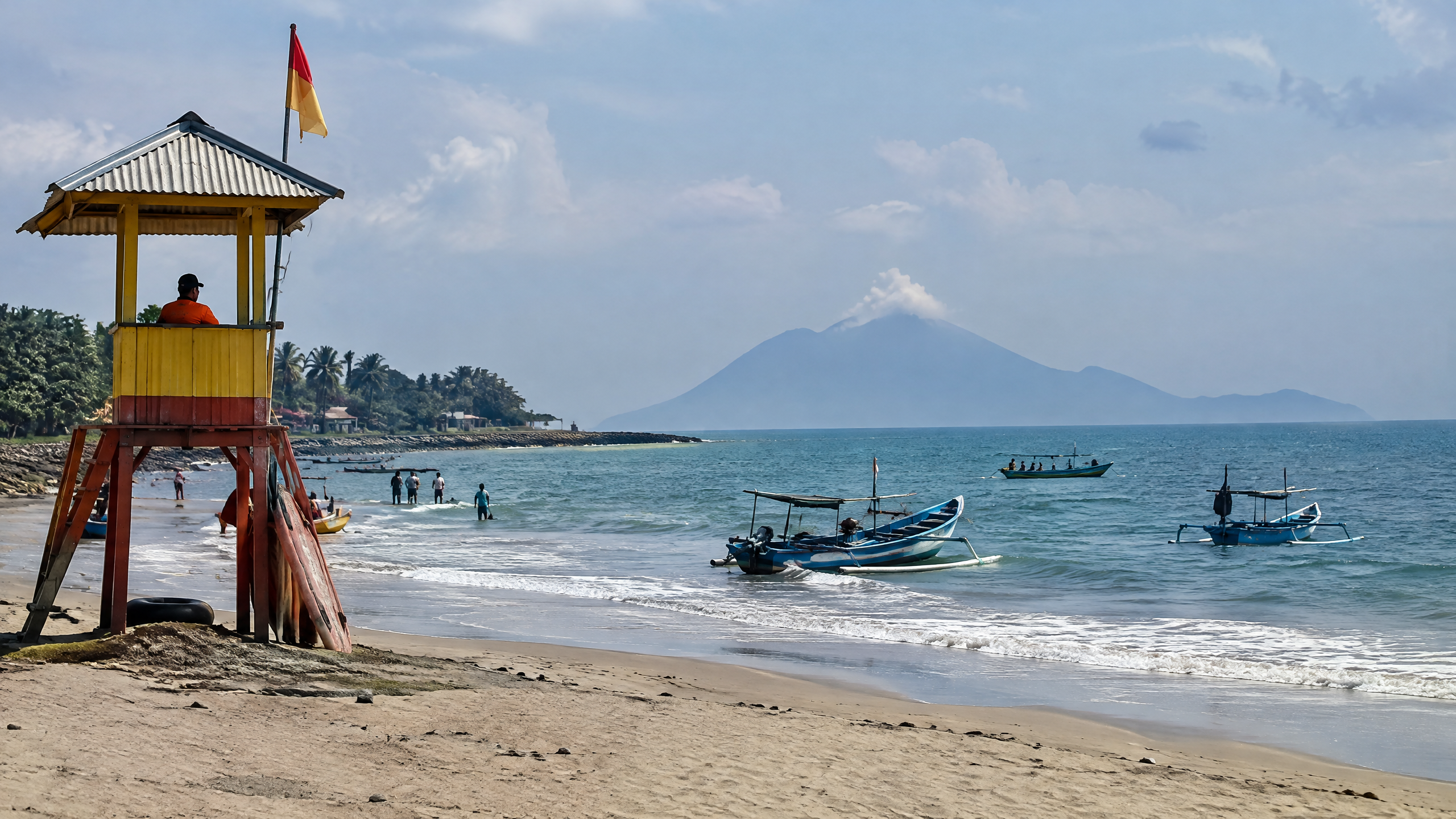
CARITA, Banten — The recovery of Banten’s western coast is being measured in more than hotel openings and busy weekends. After Anak Krakatau sent ash across the region in early September, the more precise question for visitors is whether the system around Anyer and Carita can keep beach recreation, boat movements and emergency decisions connected.
The distinction matters because the volcano’s restricted area is offshore and around the active crater, while the tourism corridor is on the Banten mainland. A beach remaining open does not automatically make every marine excursion appropriate. Nor does an eruption automatically mean that every coastal destination is closed.
What we know
- Indonesia’s Geological Agency says Anak Krakatau remains at Level III, or Siaga. Its latest activity bulletin reviewed for this report, dated September 10, says a continuous eruption from September 4 to September 6 lasted about 25 hours. Thirteen Strombolian eruptions were recorded after that episode through the bulletin period.
- Visitors, residents and climbers are prohibited from entering within 3 kilometres of the volcano’s centre of activity. The agency says the probability of further eruptions remains high, with possible incandescent rocks, heavy ash and lava if continuous activity returns.
- Official reporting recorded ashfall on the Banten coast. People affected by ash were advised to reduce outdoor activity or wear a mask. The same bulletin said residents on Banten and Lampung beaches could continue normal activities while following local disaster-agency directions.
- The latest materials reviewed do not establish a new road closure, a current boat-tour timetable or a later official change to the Level III recommendation as of September 20. Visitors should therefore verify conditions with local authorities and operators before departure.
The September disruption was also an access warning
The September episode demonstrated how volcanic activity can disrupt travel even when the main tourist corridor is not under an evacuation order. Associated ash drift prompted temporary closures at Jakarta’s Soekarno-Hatta and Halim airports and other airports, according to an Associated Press report carried by PBS NewsHour. By Sunday evening, the report said, eight airport closures had affected 170,000 passengers and 1,558 cancelled flights. Those figures describe the disruption at that time, not a continuing closure.
For Anyer and Carita, the lesson is operational. A visitor may reach the coast by road while an outbound flight, a connecting itinerary or a sea trip is affected by changing ash and weather conditions. The Geological Agency says monitoring data, rather than the number or height of eruptions alone, guides its assessment. That makes official updates more useful than photographs, rumours or assumptions based on the 2018 tsunami.
Carita’s boat launch puts marine safety in focus
The risk was underscored by the search for eight people who left from Carita’s Pagedongan pier on September 7 to report on Anak Krakatau. In an Antara report from the eighth day of the operation, Basarnas said the volcano’s vulnerability was a special consideration for the joint search team. The agency said it coordinated movements with PVMBG’s recommendations and used BMKG weather data. At that point, reported wave heights in the Sunda Strait were 0.5 to 2.5 metres, with winds of 5 to 20 knots.
The case does not establish that ordinary coastal tourism is unsafe. It does show why a boat trip toward an active volcano is a different activity from swimming or sitting on a mainland beach. Operators and visitors need clear departure limits, current marine-weather information, communication equipment and a willingness to cancel when volcanic or sea conditions change. The 3-kilometre exclusion zone is a minimum volcanic restriction, not a guarantee that conditions outside it are suitable for every vessel.
Recovery continues on land, with access still a promise
Banten’s provincial government says Anyer–Carita tourism has been rebuilding after a downturn following 2018. Its recovery programme combines better visitor services, new accommodation and facilities, village tourism and support for local micro, small and medium enterprises. Governor Andra Soni has also said the Serang–Panimbang toll road is expected to improve access to the Anyer–Cinangka–Carita area when completed.
That wording is important: improved access is an expectation, not evidence that every journey is already faster or that all infrastructure works are finished. The official provincial material reviewed for this report does not provide a current travel-time guarantee, traffic forecast or construction-completion date. Road users should check live traffic information and local instructions, especially during weekends and after weather or volcanic-ash events.
What a safer reopening looks like
The provincial government reported in July that activity in Anyer and Carita was continuing normally while mitigation was being strengthened. It said BPBD coordination with PVMBG, BMKG, the military, police and local governments was being reinforced, and that water-rescue tourism personnel were being trained for rapid evacuation if a tsunami warning required it. A normal day at the beach is therefore compatible with preparedness, not a substitute for it.
For visitors, the practical standard is simple. Check the latest PVMBG or MAGMA Indonesia bulletin before travelling. Ask a hotel or beach manager about local instructions, ash conditions and evacuation routes. Do not enter the crater exclusion zone or book a trip that approaches it. For any boat journey, confirm the operator’s route, weather check and return plan. If authorities change the recommendation, leave the coast or cancel the excursion without waiting for visual confirmation.
Anyer and Carita can continue their economic recovery without pretending that volcanic risk has disappeared. The strongest version of that recovery is not a promise of uninterrupted tourism. It is a coastal destination where access improves, businesses reopen responsibly and every visitor knows which official signal takes precedence over a crowded beach.
Sources
- https://geologi.esdm.go.id/media-center/perkembangan-erupsi-gunungapi-anak-krakatau-tanggal-10-september-2026
- https://www.esdm.go.id/id/media-center/arsip-berita/aktivitas-anak-krakatau-terus-dipantau-pvmbg-pastikan-status-siaga-tetap-berlaku-usai-erupsi-menerus-25-jam
- https://bantenprov.go.id/index.php/berita/wisata-anyer-carita-ramai-pemprov-banten-perkuat-mitigasi-pasca-status-siaga-anak-krakatau
- https://bantenprov.go.id/video/anyer-carita-perlahan-bangkit-lag
- https://bantenprov.go.id/berita/gubernur-andra-soni-optimistis-anyer-carita-kembali-jadi-destinasi-wisata-unggulan
- https://www.pbs.org/newshour/world/volcanic-island-in-indonesia-erupts-forcing-the-cancellation-of-hundreds-of-flights
- https://kupang.antaranews.com/berita/199661/basarnas-kerentanan-aktivitas-anak-krakatau-menjadi-pertimbangan-pencarian-jurnalis
- https://reliefweb.int/report/indonesia/indonesian-humanitarian-coordination-platform-flash-update-no-1-anak-krakatau-eruption-volcanic-ashfall-and-concurrent-forest-fire-haze-situation-6-september-2026