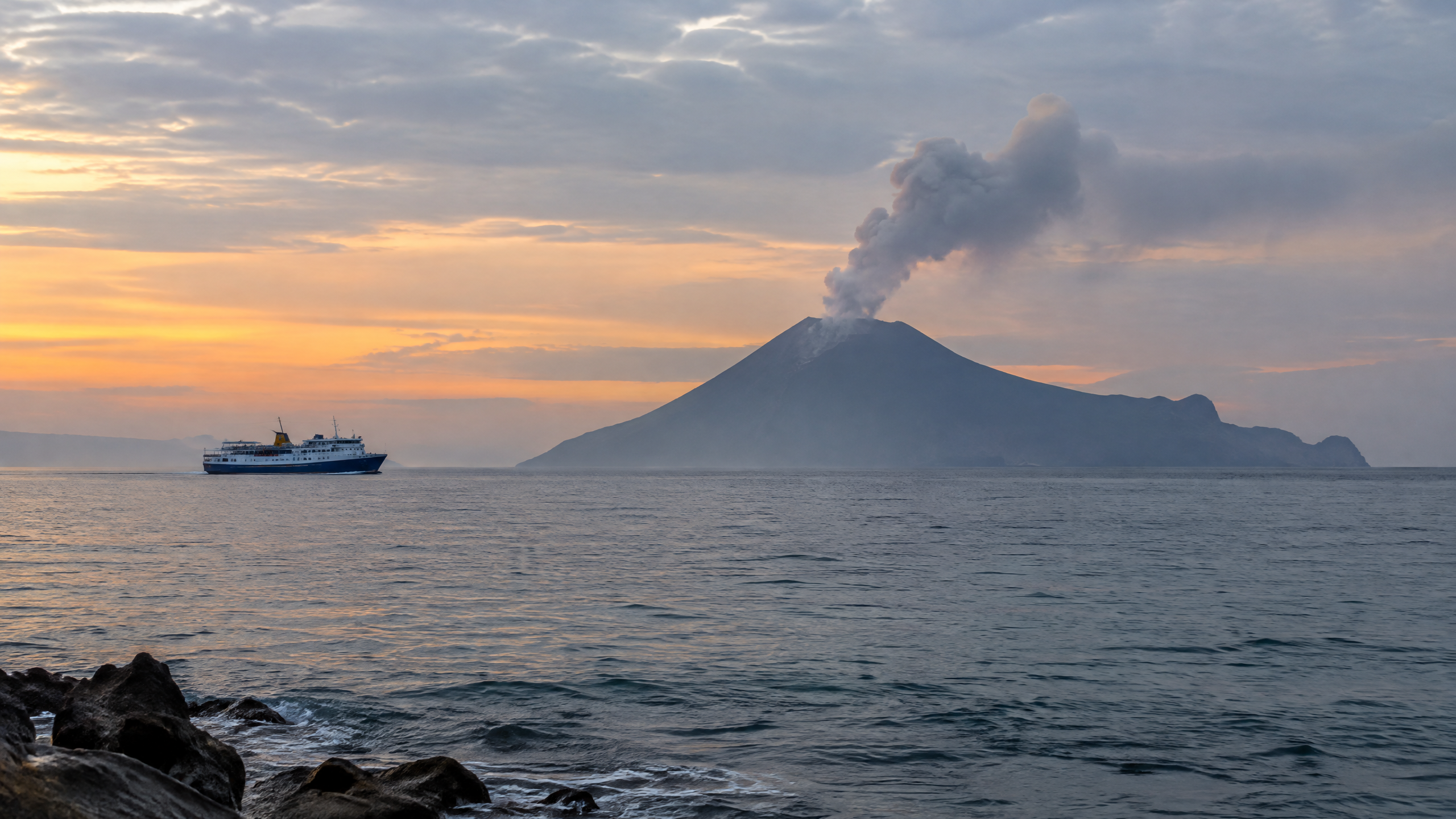
SERANG, Banten — The most important change for travelers around the Sunda Strait after Anak Krakatau’s September eruption is not a permanent route closure. It is a new planning rule: build the itinerary around official updates, not around a fixed departure time.
Anak Krakatau’s continuous eruption began at 23:07 local time on September 4 and continued for about 25 hours, according to Indonesia’s Geological Agency. The activity sent ash into air routes over western Indonesia and temporarily closed eight airports on Java and Sumatra. By September 8, airports had resumed operations, but the volcano remained at Level III, or Siaga (Alert), and authorities continued to warn that further eruptions were possible.
Air travel became the main source of uncertainty
For visitors heading to Banten’s coastal resorts, Krakatau viewpoints or onward destinations in Sumatra, the disruption showed how quickly a trip based on one flight can unravel. BMKG reported that ash was detected at different heights and moved in different directions. On September 6, one ash area reached 20,000 feet toward the east while another reached 50,000 feet toward the west. On September 7, BMKG said ash was observed up to 15,000 feet and had spread across parts of Banten, western Java, Lampung and Bengkulu.
The response was therefore dynamic rather than tied to a single closure notice. BMKG issued aviation warnings, while AirNav Indonesia used NOTAMs to support temporary shutdowns. The eight airports affected on September 7 included Soekarno-Hatta and Halim Perdanakusuma in the Jakarta area, Radin Inten II in Lampung, Husein Sastranegara in Bandung, Budiarto in Curug, Pondok Cabe, Muhammad Taufiq Kiemas and Atungbusu.
The scale of the knock-on effect was substantial. The BBC reported that nearly 3,000 flights were disrupted and more than 340,000 passengers were stranded during the extended closures. An Associated Press report published by PBS counted 1,558 cancelled flights and 170,000 affected passengers by Sunday evening, showing that passenger totals changed as the disruption developed and was measured at different points.
For travelers, the practical lesson is to check the operating status of both the departure and arrival airports shortly before leaving for the terminal, then check the airline’s rebooking policy. A same-day connection through Jakarta is now a fragile plan when ash advisories are active. A longer buffer, a changeable ticket and an overnight option on either side of a flight are more valuable than a tightly packed itinerary.
The ferry question is different from the flight question
The eruption did not automatically mean that the entire Sunda Strait crossing was closed. In its September 7 update, BMKG said the crossing lane was in safe condition at that time. Its HF Radar monitoring from Carita and Tanjung Lesung put the probability of a tsunami in the low category, below 50 percent, while 20 tsunami gauges detected no sea-level anomaly indicating a tsunami. BMKG reported surface currents of 0.4–0.9 knots and waves of 0.3–1.2 metres, with a seven-day wave forecast of 0.5–2.0 metres for September 8–13.
Those figures were a snapshot, not a guarantee for every sailing. Travelers should not infer that a favorable marine bulletin cancels a volcanic exclusion zone or overrides a ferry operator’s decision. The correct approach is to check the latest BMKG marine information and the transport operator’s sailing notice separately. A traveler who sees a flight cancellation should not assume the ferry is also closed; nor should a calm sea forecast be treated as permission to approach the volcano.
The 3-kilometer rule changes what counts as a Krakatau trip
Under the Geological Agency’s Level III recommendation, residents, tourists and climbers may not enter or conduct activities within a 3-kilometer radius of the active crater. The agency says the current hazards include incandescent rock, heavy ash and, if continuous eruption returns, lava flows. Its September 11 update said surface activity had eased into intermittent Strombolian eruptions, but deeper volcanic earthquakes had increased compared with the average and the potential for another eruption remained high.
That makes a close-up boat excursion or a “wait and see” landing at the volcanic island an unsuitable anchor for a holiday plan. The safer travel product is a flexible coastal itinerary that treats Krakatau as a monitored landscape, not a guaranteed attraction. Banten’s shore can remain part of a trip, but the volcano itself must remain outside the exclusion zone and subject to official instructions.
Hotels and operators are now part of the contingency plan
The Tourism Ministry told ANTARA that it was coordinating with hotels and tourism-area operators in Banten, Lampung and locations near affected airports. Measures included force-majeure procedures, emergency waiting rooms, more flexible check-out arrangements for passengers delayed by flight disruptions, ash cleaning under safety procedures, air-quality monitoring and evacuation-route preparation.
Travelers should ask accommodation providers in advance how those measures are applied, particularly if an ash-related cancellation creates an unplanned overnight stay. Keep written booking confirmations, allow time for a possible rebooking and avoid assuming that a force-majeure policy automatically means a full refund; the terms remain a matter for the operator, airline or booking platform.
What we know
- The continuous eruption ran from September 4 to September 6, lasting about 25 hours; the volcano remained at Level III (Siaga) in the Geological Agency’s September 11 update.
- Authorities barred visitors, climbers, boats and other activities within 3 kilometres of the active crater.
- Volcanic ash temporarily disrupted eight airports, while airports were reported to have resumed operations by September 8.
- BMKG found no tsunami anomaly in its September 7 monitoring and reported the Sunda Strait crossing lane safe at that time, but marine and aviation conditions remain time-sensitive.
- This article uses official updates available through September 11 and travel-disruption reporting published through September 8. No newer official operational bulletin was identified for September 20; travelers should verify conditions immediately before departure through BMKG, PVMBG/Geological Agency, local authorities and their transport operator.
The September eruption did not eliminate travel around the Sunda Strait. It made verification, spare time and a credible fallback route essential parts of the itinerary.
Sources
- https://geologi.esdm.go.id/media-center/fenomena-erupsi-menerus-gunungapi-anak-krakatau-tanggal-5-september-2026
- https://www.bmkg.go.id/siaran-pers/bmkg-terus-pantau-dampak-erupsi-gunung-anak-krakatau
- https://www.bmkg.go.id/siaran-pers/imbas-sebaran-abu-vulknaik-anak-krakatau-8-bandara-ditutup-sementara-bmkg-minta-waspada-dan-tenang
- https://www.esdm.go.id/en/media-center/news-archives/erupsi-menerus-anak-krakatau-berakhir-aktivitas-gunung-api-kembali-menurun-dan-tetap-dipantau
- https://esdm.go.id/en/media-center/news-archives/intensitas-erupsi-anak-krakatau-menurun-badan-geologi-tetap-waspadai-aktivitas-magma-dalam
- https://en.antaranews.com/news/430705/ministry-works-to-help-tourists-affected-by-anak-krakatau-eruption
- https://www.bbc.com/news/articles/czezydp4l97o
- https://www.pbs.org/newshour/world/volcanic-island-in-indonesia-erupts-forcing-the-cancellation-of-hundreds-of-flights
- https://science.nasa.gov/earth/earth-observatory/anak-krakatau-rumbles-again/