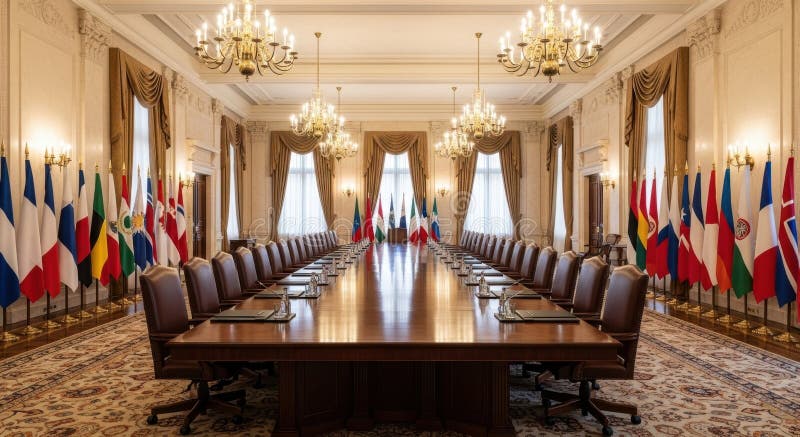
# Global Diplomacy Shift: Small Nations Gaining Influence in Major Peace Talks
In a compact conference room in Doha, a delegation from a neighbouring country leans forward as a Qatari facilitator quietly rearranges the agenda. Across the ocean, a discreet meeting in Oslo follows a centuries-old pattern of mediation. In Jakarta, officials recall the 2005 Aceh negotiations as proof that nimble diplomacy can deliver results where great-power rivalry stalls. These vignettes capture a widening trend: smaller and mid-sized states are increasingly stepping into the breach to broker, host and shape major peace talks once dominated by global powers.
For decades, the architecture of peace diplomacy reflected the hierarchies of international power: great powers set the terms, regional heavyweights provided muscle, and smaller states rarely took centre stage. That model is shifting. Diplomacy scholars, veteran negotiators and foreign ministries point to an expanding role for countries that trade in neutrality, credibility and facilitation rather than coercive power. Norway, Qatar, Switzerland and Indonesia — among others — now headline chapters in conflict resolution from the Balkans to Afghanistan, and the trend shows few signs of reversing.
Historical precedents and recent practice
The pattern is not entirely new. Norway’s role in the 1993 Oslo process remains an oft-cited landmark of discreet facilitation. Switzerland’s reputation for neutrality and its hosting of Geneva conventions and peace talks have made it a perennial platform for multi-sided diplomacy. More recently, Qatar provided the venue and logistical backing for U.S.-Taliban talks in Doha during the 2010s, while Indonesia’s fractious domestic settlement in Aceh and subsequent mediation in 2005 are widely regarded as a model for pragmatic, locally informed peacemaking.
What is new is scale and frequency. Observers note that the number of significant mediation initiatives involving small or medium-sized states has risen in the past decade. Countries with credibility, resources and a willingness to act as honest brokers are being invited into processes where major powers either prefer to stay on the sidelines or are too polarized to mediate effectively.
Why smaller states are winning diplomatic space
Several factors explain the shift. First, neutrality or perceived impartiality is a powerful asset in highly polarized conflicts. Small states can credibly claim the absence of geopolitical stakes that would otherwise taint their mediation. Second, hosting capacity matters: modern peace processes require secure venues, robust logistics, and the diplomatic bandwidth to coordinate international participants — capabilities that Qatar and Switzerland have demonstrated repeatedly.
Third, connectivity and soft power are increasingly fungible in diplomacy. Development aid, quiet backchannel contacts, and cultural or religious ties allow smaller nations to exert influence without military or economic coercion. Fourth, the fragmentation of traditional power blocs leaves gaps that nimble actors can exploit. Where larger powers are distracted by competition or internal politics, smaller states can offer continuity and patient engagement.
Case studies and concrete details
– Qatar: Doha’s ability to host prolonged talks, provide media infrastructure and arrange secure movement helped sustain negotiations around Afghanistan and other regional conflicts. Its investment in shuttle diplomacy is backed by diplomatic staff experienced in multilateral coordination.
– Norway: The Norwegian model emphasizes confidentiality, shuttle diplomacy and technical support — elements that proved vital in the Oslo process and in later Balkan and Middle East mediation efforts.
– Indonesia: As a regional power with recent success in settling internal conflict, Indonesia combines local knowledge, linguistic capacity and regional legitimacy, enabling it to mediate in Southeast Asian disputes and offer a model for other middle powers.
– Switzerland and Kazakhstan: Geneva remains a go-to neutral ground, while Central Asian states such as Kazakhstan have hosted formats — notably in Eurasian and Syrian discussions — where a neutral geography and administrative competence mattered.
Risks and limits
The rise of smaller mediators is not a panacea. Mediators must be trusted by all parties, and even neutral hosts can be drawn into proxy disputes. Resources — financial, diplomatic and security — can limit sustained engagement. Moreover, where core strategic interests of major powers are involved, smaller states may lack leverage to produce a durable outcome without broader international buy-in.
Policy implications
For conflict-affected parties and sponsoring states, the implication is clear: diversified mediation ecosystems can increase the chances for dialogue, but success depends on coordination, resourcing and the willingness of major powers to support credible third-party initiatives. Donors and international organizations may need to adapt by investing in the capacities of neutral hosts and offering guarantees that amplify, rather than displace, local initiatives.
Concluding summary
The diplomatic landscape is adapting to geopolitical fragmentation and growing demand for impartial facilitation. Smaller and mid-sized states are proving that leverage can be built from credibility, logistics and patience as much as from military or economic might. While limitations remain — especially when great-power interests are in play — the pattern is unmistakable: in peace talks where trust and facilitation count, the quiet leverage of small states increasingly shapes outcomes. For observers and practitioners alike, the lesson is to nurture a wider toolkit for peacemaking that recognizes the comparative advantages of these unexpected, and often effective, actors.