The Banten Post –
Old Banten Sultanate History: The Rise and Legacy of Java’s Greatest Islamic Kingdom
The Banten Sultanate was one of the most powerful and influential Islamic kingdoms in Southeast Asia during the 16th and 17th centuries. Founded in 1526, it ruled over the westernmost part of Java and controlled critical trade routes through the Sunda Strait. At its height, the sultanate was a major center of international trade, Islamic scholarship, and political power, rivaling even the mighty Mataram kingdom to the east. This article traces the history of the Old Banten Sultanate, its golden age, and the remarkable archaeological legacy it left behind in what is now Serang Regency.
The Founding of the Banten Sultanate
The Banten Sultanate was established by Sultan Maulana Hasanuddin in 1526, following the conversion of the local population to Islam under the influence of Islamic missionaries from the Middle East and the Demak Sultanate in Central Java. The sultanate’s capital was established at Banten Lama (Old Banten), a strategic location on the northwest coast of Java that provided access to both the Java Sea and the Sunda Strait.
The sultanate’s founders recognized the immense commercial potential of their location. Banten controlled the pepper trade from the surrounding highlands and served as a critical stop for international merchants traveling between India, the Middle East, China, and the Spice Islands of eastern Indonesia.
The Golden Age: Sultan Agung’s Reign
The Banten Sultanate reached its zenith during the reign of Sultan Ageng Tirtayasa (1651-1683), who is widely regarded as the greatest ruler in Banten’s history. Under his leadership, the sultanate expanded its territory to include Lampung (Sumatra), controlled the pepper trade, and established diplomatic relations with European powers, the Ottoman Empire, and other Asian kingdoms.
Sultan Ageng Tirtayasa was a visionary ruler who invested heavily in infrastructure, including the construction of the Great Mosque of Banten (Masjid Agung Banten), one of the oldest and most important mosques in Indonesia. The mosque’s distinctive multi-tiered roof reflects a blend of Javanese, Chinese, and Islamic architectural influences, symbolizing the cosmopolitan character of the sultanate.
The sultanate’s prosperity during this period was reflected in its urban planning. Banten Lama was described by European visitors as a bustling city with wide streets, a grand marketplace, and a population that included Javanese, Sundanese, Chinese, Arab, Indian, and European merchants.
European Contact and Conflict
The arrival of European traders in the early 17th century marked a turning point in Banten’s history. The Dutch East India Company (VOC) established a trading post at Banten in 1603 and quickly became a dominant force in the region’s commerce. The VOC’s growing influence led to increasing tension with the sultanate, culminating in a series of conflicts that would ultimately undermine Banten’s independence.
In 1682, Sultan Ageng Tirtayasa was deposed by his son, Sultan Haji, who had allied with the VOC. This internal conflict, combined with Dutch military pressure, marked the beginning of the sultanate’s decline. The VOC gradually assumed control of Banten’s trade and administration, reducing the sultanate to a vassal state.
The Decline and Abolition of the Sultanate
Throughout the 18th and 19th centuries, the Banten Sultanate continued to decline. Dutch colonial rule tightened its grip on the region, and the sultanate’s territory was progressively reduced. In 1813, the British (who had temporarily occupied Java during the Napoleonic Wars) formally abolished the sultanate, although it was briefly restored before being definitively dismantled by the Dutch in the 1830s.
Despite the abolition of the sultanate, its cultural and religious legacy endures. The descendants of the royal family remain influential in the region, and the institutions of Islamic scholarship established during the sultanate’s golden age continue to operate.
The Archaeological Sites of Old Banten
Today, the ruins of the Old Banten Sultanate are preserved as an important archaeological heritage site. Key locations include:
Keraton Surosowan: The ruins of the sultan’s palace, built around 1526, cover an area of approximately 4 hectares. The palace was surrounded by a massive defensive wall and featured an elaborate system of canals and reservoirs. Today, only the foundations and scattered brickwork remain, but the scale of the complex is still impressive.
Masjid Agung Banten (The Great Mosque): Built in the 16th century, this mosque is one of the oldest surviving Islamic buildings in Java. Its distinctive architecture, including the multi-tiered roof, the brick minaret (menara), and the ornate mihrab (prayer niche), reflects the artistic achievement of the Banten period.
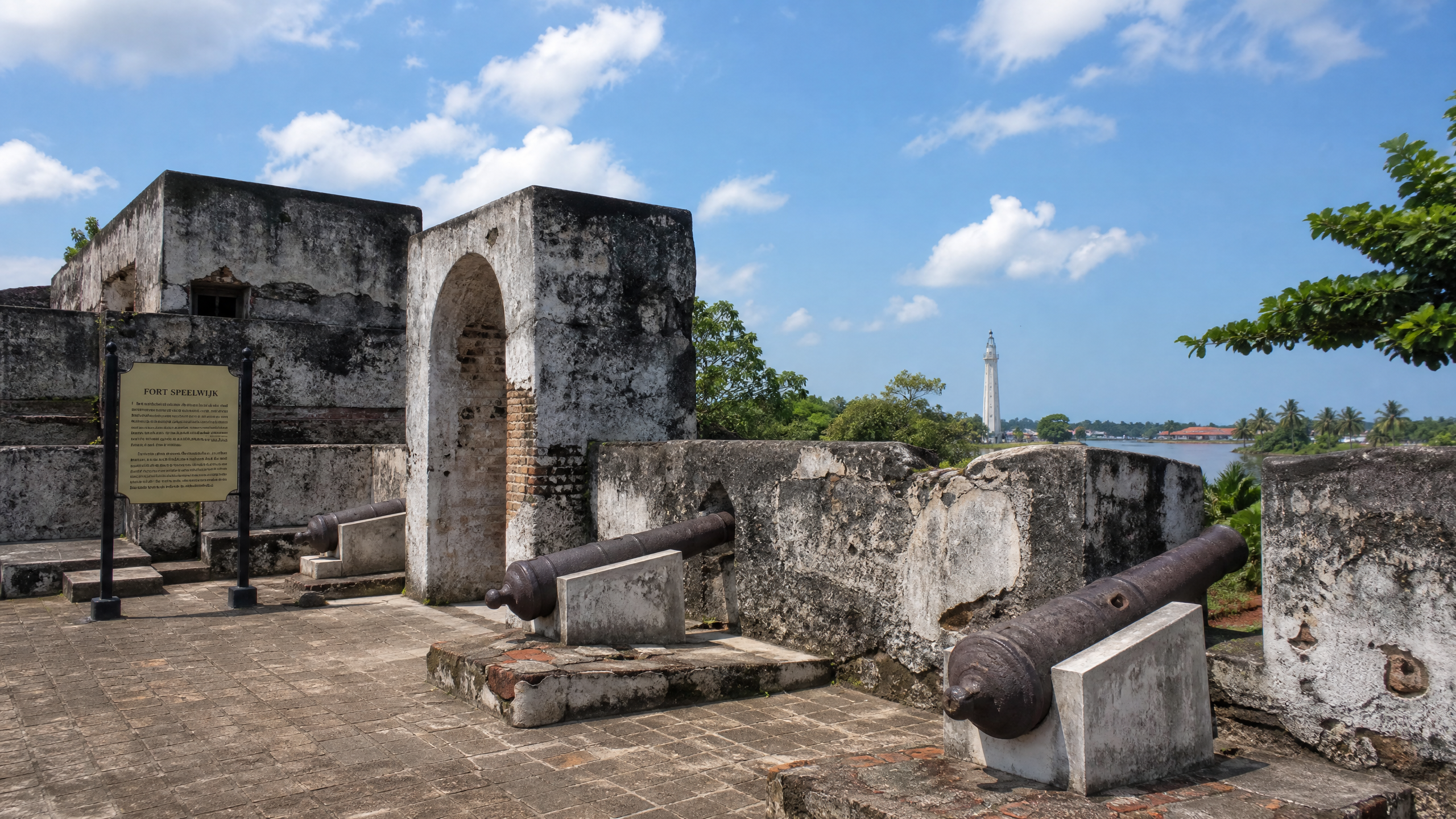
Fort Speelwijk: A Dutch colonial fort built in the 17th century to protect the VOC trading post. The fort’s ruins provide insight into the colonial history of the region.
Vihara Avalokitesvara: A Chinese temple located near the mosque, reflecting the multicultural character of Old Banten during the sultanate’s golden age.
Makam Maulana Hasanuddin: The tomb of the sultanate’s founder, located near the Great Mosque. It is a site of pilgrimage for Muslims who revere the sultan as a key figure in the spread of Islam in Java.
Legacy and Significance
The Old Banten Sultanate left an indelible mark on the cultural, religious, and political landscape of western Java. Its contributions to Islamic scholarship, international trade, and architectural innovation continue to be studied and celebrated. The archaeological sites at Old Banten are not merely ruins; they are a testament to a civilization that once stood among the most advanced and prosperous in Southeast Asia.
For visitors interested in Indonesian history, the Old Banten Sultanate sites offer a fascinating journey through one of the archipelago’s most important kingdoms. The combination of Islamic architecture, colonial fortifications, and multicultural heritage makes Old Banten a unique destination that deserves greater recognition on the international tourism circuit.