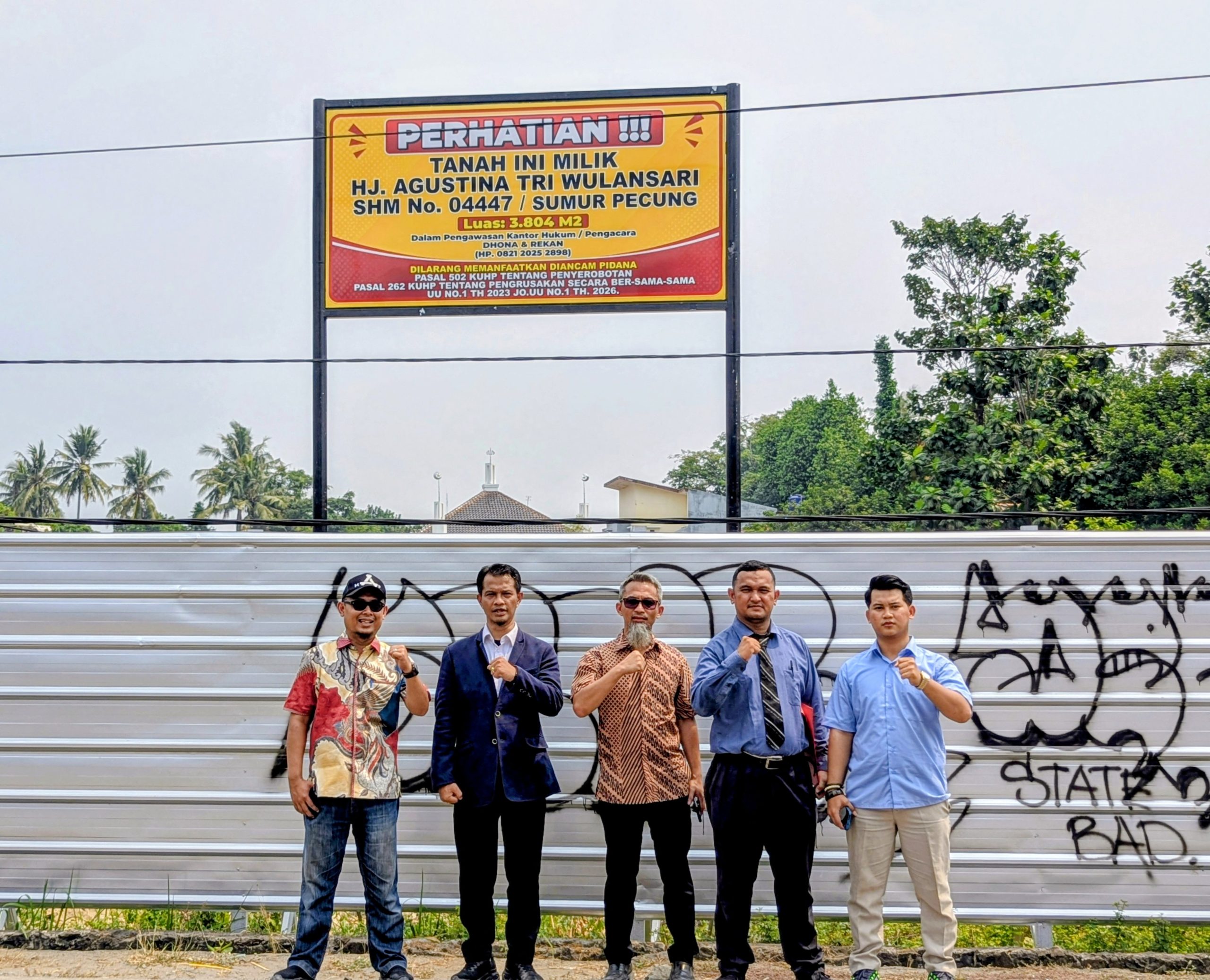
SERANG CITY – Hj. Agustina Tri Wulansari, the holder of Freehold Title Certificate (SHM) No. 04447, on Thursday installed an ownership sign on a parcel of land located on Jalan Raya Bhayangkara in Serang City. She was accompanied by her legal team from Dhona & Partners Law Office, which described the move as a formal assertion of her ownership rights and a legal response to what it called a unilateral claim over the property by I Nyoman Rubrata.
Dhona El Furqon, legal counsel for Hj. Agustina Tri Wulansari, said the installation of the sign was intended to safeguard ownership rights that had already been recognised by the Indonesian government through the issuance of SHM No. 04447. He argued that any attempt to occupy, obstruct, or take control of the land without a lawful basis could not be justified under Indonesian law.
“Our client is not merely claiming ownership of the land. She holds a Freehold Title Certificate that has been officially issued and recognised by the State. The certificate remains valid and has never been revoked or annulled by a final and binding court decision. Therefore, our client’s ownership rights must be respected by everyone,” Dhona told reporters on Thursday (30 July 2026).
According to Dhona, the legal positions of the two parties are fundamentally different. He argued that if I Nyoman Rubrata is only now seeking to register or establish rights over the land while Hj. Agustina Tri Wulansari already possesses a legally issued ownership certificate, the two claims cannot be regarded as having equal legal standing.
“Indonesia’s land law is built on the principle of legal certainty, as provided under Law No. 5 of 1960 on Basic Agrarian Principles and Government Regulation No. 24 of 1997 on Land Registration. A Freehold Title Certificate constitutes strong legal evidence of both the physical and juridical status of a parcel of land unless a court determines otherwise,” he said.
The legal team also argued that actions such as erecting fences, filling the land, or otherwise taking physical control of the property without lawful authority could expose those responsible to both civil and criminal liability.
Dhona said such conduct could amount to an unlawful act under Article 1365 of Indonesia’s Civil Code. He further argued that occupying another person’s land without legal entitlement could also fall within the scope of Article 502 of Law No. 1 of 2023, Indonesia’s Criminal Code, concerning the offence of land grabbing, provided investigators conclude that all legal elements of the offence have been satisfied.
He also stressed that the rule of law leaves no room for anyone to obtain or maintain control over land through coercion, intimidation, or actions resembling vigilantism.
“In our view, physically occupying land, erecting fences, filling the site, or asserting ownership without a valid legal basis is not a lawful way to resolve a land dispute. Such conduct amounts to vigilantism. Anyone who believes they have legitimate rights over the property should pursue those claims through the legal process, not through unilateral actions that could escalate tensions on the ground,” he said.
Hj. Agustina Tri Wulansari’s legal team said their client would continue defending her ownership rights through the legal process and would refer any suspected criminal offences or unlawful acts affecting SHM No. 04447 to law enforcement authorities.
“We urge all parties to respect the principle of legal certainty. The State has already recognised our client’s ownership rights through the issuance of a Freehold Title Certificate. Anyone who believes they have competing rights should establish those claims through the proper legal process, rather than through unilateral actions at the site,” Dhona added.
As part of its efforts to safeguard its client’s legal interests, Dhona & Partners Law Office said it is prepared to pursue all available legal remedies, including civil, criminal and administrative proceedings under Indonesia’s land laws, against any party alleged to have unlawfully occupied or exercised control over the certified property.